November 14, 2026
Law Firm AI Receptionist Guide: Intake, Ethics and Cost
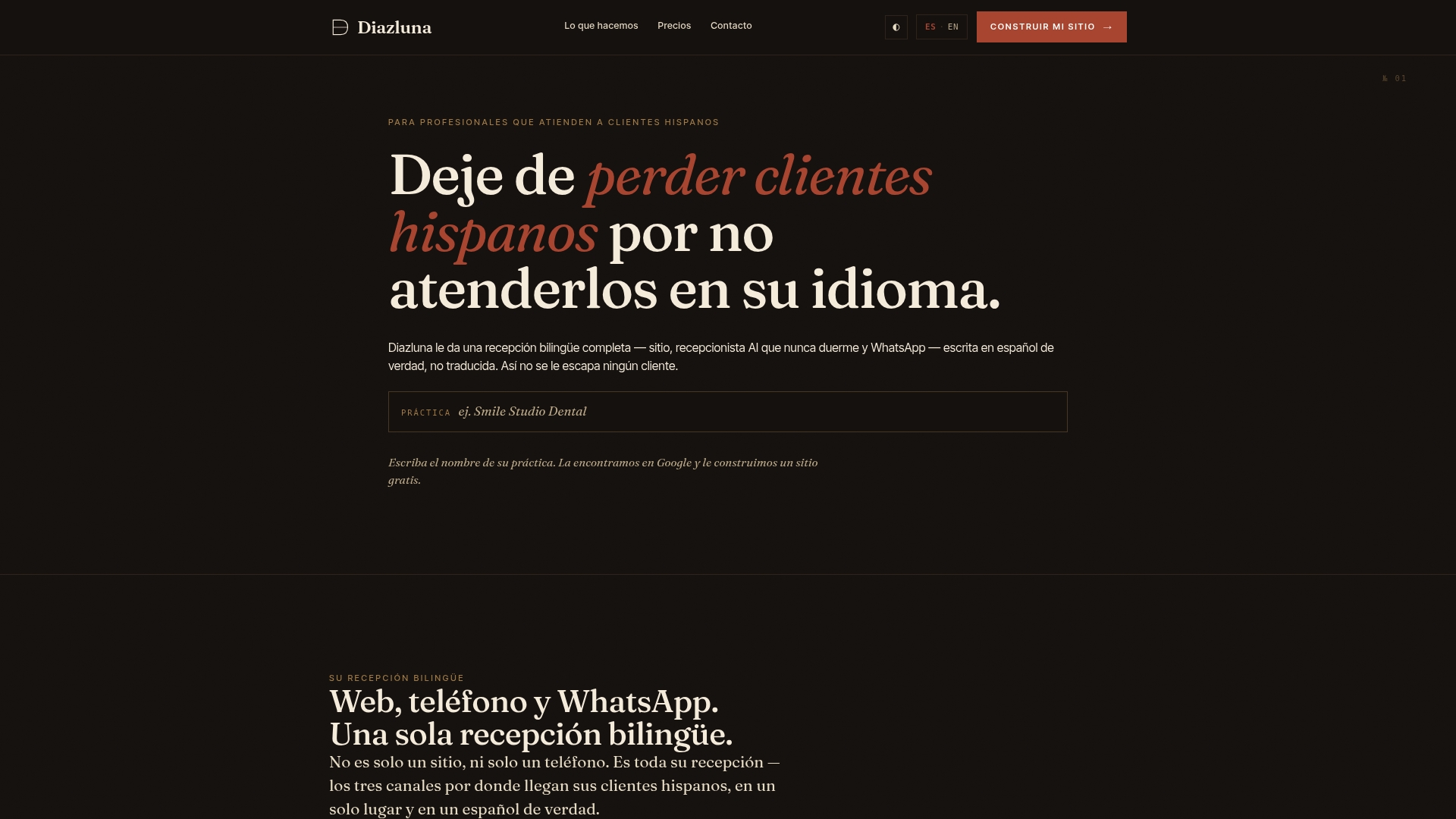
An AI receptionist for a law firm answers every call and message, collects the details of a prospective client, books the consultation and sends urgent matters to a person, all without giving legal advice. For firms with Spanish-speaking clients, the best setup does this in both languages on the phone, on WhatsApp and on the website, so the caller who reaches you at 9 p.m. in Spanish is not left with voicemail. That is how we built Diazluna: a bilingual front desk for practices serving Hispanic clients, with a 24/7 AI receptionist, a bilingual website and WhatsApp working together.
This guide covers what the tool should handle, what it must never do, the ethics rules that apply, how to set up bilingual intake, what it costs and how to roll it out.
TL;DR
- An AI receptionist should do intake, scheduling and urgent routing. It must never give legal advice, quote outcomes or accept a case. Those stay with a lawyer.
- ABA Formal Opinion 512 and the New York City Bar opinions on recording make confidentiality, consent and human review the core of safe use.
- A bilingual setup (website, phone and WhatsApp in authentic Spanish) keeps Spanish-speaking prospects from hanging up or calling the next firm.
- Diazluna plans run from $99 per month for the website alone to $349 per month for the Pro package, plus a one-off $399 activation.
- Roll out in four steps: define scope, write the intake script, test with real scenarios, review summaries weekly.
Table of Contents
- What an AI receptionist does for a law firm
- What it must never say or do
- Ethics, confidentiality and recording
- Intake that works: what to collect and how to route
- Authentic bilingual intake for Spanish-speaking clients
- What an AI receptionist costs
- How to roll it out in four steps
- Our view
- Start with the front desk your Spanish-speaking clients can reach
- FAQ
- Sources
What an AI receptionist does for a law firm
A law firm’s phone does three jobs: it captures new matters, it serves existing clients and it filters noise. A person can do all three but not at 7 a.m., at lunch, on a Saturday or while on another call. An AI receptionist covers the gaps. In practice it:
- answers calls and messages immediately, at any hour;
- asks the intake questions you define: name, callback number, language, type of matter, a short description of what happened;
- offers consultation times from your calendar;
- flags urgent situations and transfers the caller to the attorney or staff member on call;
- sends your team a summary so nobody has to replay a recording.
Diazluna’s receptionist works this way: it manages calls, messages and appointment scheduling, gives your team real-time summaries and transfers urgent cases. If you want the plain-language basics first, our explainer on what a 24/7 legal AI receptionist is walks through the idea from scratch.
Where it fits compared with other options
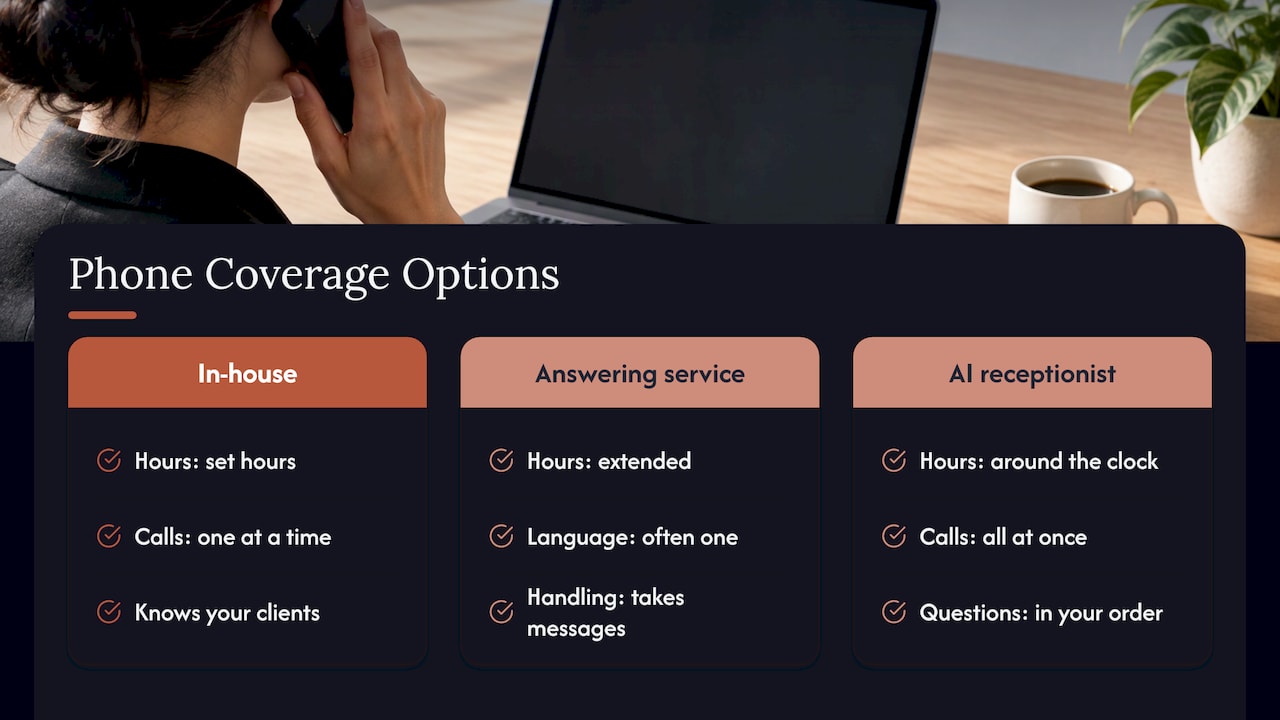
Firms usually weigh three options for covering the phone: an in-house receptionist, a human answering service and an AI receptionist. A staff member knows your clients but works set hours and can only take one call at a time. An answering service extends the hours but often reads from a script in one language and takes messages. An AI receptionist answers every call at once, around the clock, and can be configured to ask your questions in your order. For a small firm that loses calls during hearings, depositions and nights, the practical difference is that no call goes unanswered.
What it must never say or do
The line between intake and legal advice is the most important design decision in the whole project. Callers will ask: “Do I have a case?”, “How much is it worth?”, “Should I sign this?” The receptionist’s answer is always the same: it cannot advise, but it can book a consultation with an attorney.
The ABA’s guidance backs this up. ABA Formal Opinion 512, issued on July 29, 2024, says lawyers using generative AI may not leave it to the tool alone to offer legal advice to clients, negotiate claims or perform other functions that require a lawyer’s personal judgment. The opinion also covers competence, client communication, supervision of staff and agents, and reasonable fees.
Translate that into a written scope for your receptionist:
| It can | It must not |
|---|---|
| Collect contact details and a short description of the matter | Tell a caller whether they have a case |
| Ask conflict-check basics, such as names of the other parties | Estimate damages, fees for an outcome or timelines for a result |
| Book, move or confirm consultations | Accept a matter or promise representation |
| Transfer urgent callers to a person | Interpret a document or deadline for the caller |
| Answer general office questions: hours, location, languages spoken | Negotiate or discuss settlement |
An attorney who works on legal intake software, quoted on the AI Esquire site, makes a point worth keeping: scope belongs in the workflow, staff training, configuration, test scenarios and quality review, and a disclaimer cannot repair a system that is designed to cross the line (AI Esquire, August 2026). A line like “I can’t give legal advice” at the start of a call is good, but the real protection is that the system never asks for or offers more than your script allows.
Ethics, confidentiality and recording
This is the part that makes a law firm different from a dental office or a retail store. You owe duties of confidentiality even to people who never become clients. Four points matter most.
Understand the tool and protect what callers tell it
Under Opinion 512, a lawyer must have a reasonable understanding of a generative AI tool’s capabilities and limitations, and must evaluate the risk that information about a client could be disclosed to or accessed by people outside the firm before entering it. The opinion also says informed client consent is required before putting information into a self-learning tool, and that boilerplate added to an engagement letter is not enough (ABA Formal Opinion 512). Ask any vendor where call data is stored, who can access it and whether it is used to train a model, and get the answers in writing before you go live.
Get consent before recording
The New York City Bar’s Formal Opinion 2025-6, from December 2025, concludes that an attorney should obtain client consent before recording a call with an AI tool. It notes that many states require two-party consent to lawfully record telephone calls and that some states protect biometric data, including voiceprints. In August 2026, Formal Opinion 2026-2 extended the same approach to non-client conversations: get the consent of all other parties before recording and, as a default, avoid recording at all because of the ethical and tactical risks.
For your firm, that means a greeting that tells the caller they are speaking with an AI assistant and, if you record, asks for consent in the language the caller is using. Which state’s law applies depends on where you and the caller are. Have your own state bar’s ethics guidance or your ethics counsel confirm the exact wording before launch.
Review what the AI produces
The same New York opinion says the duty of competence under Rule 1.1 means attorneys should independently review any recording, transcript or summary an AI tool generates to make sure it reflects the conversation accurately. Build this into the routine: a named person reads the intake summaries each day, corrects errors and follows up on anything unclear. Summaries are the starting point for a lawyer’s call back, not the final record.
Supervise it like staff
Opinion 512 also addresses supervision under Rules 5.1 and 5.3 and misrepresentation under Rule 8.4(c). An AI receptionist that pretends to be a human, or that implies a lawyer is on the line when none is, creates exactly that risk. Disclose that it is an AI. Some states have also been adding bot-disclosure laws, so check what applies where you practice.
Intake that works: what to collect and how to route
A good intake script is short enough that callers finish it and specific enough that an attorney can act on it. Start with this sequence:
- Language. Ask which language the caller prefers and switch immediately.
- Contact details. Name, best phone number, WhatsApp if they use it, and a safe time to call back.
- Matter type. A short menu: immigration, personal injury, family, criminal, employment, other.
- The facts in the caller’s words. One open question, then two or three follow-ups by matter type.
- Parties involved. Names of the other side, an employer, an insurer or a co-defendant, so your team can run a conflict check.
- Urgency. Is there a court date, an arrest, a deadline, a detention or a safety concern in the next few days?
- Next step. Offer a consultation slot or promise a callback within a stated window.
Matter-specific questions should differ. A car-crash caller needs the date, injuries and insurer. An immigration caller needs the stage of the case and any notice received. A criminal caller needs custody status and the next hearing. Keep each list to what the attorney actually uses.
Urgent calls and warm transfers
Define “urgent” in writing: someone in custody, a hearing within days, a restraining order, a detention, a deadline about to pass. The receptionist should send those callers directly to the on-call attorney or paralegal, with a summary of what the caller has said so far, so they do not have to repeat themselves. Diazluna’s receptionist transfers urgent cases and sends summaries. Decide who is on call, what the backup is when they do not pick up and how long the caller waits before the system takes a message and alerts the whole team.
Existing clients
Existing clients calling about their matters should reach the assigned team quickly. Set the receptionist to take a message, flag it to the right person and never discuss case details beyond what you have authorized.
Authentic bilingual intake for Spanish-speaking clients
For a firm serving Hispanic communities, language is the first intake question and often the deciding one. A caller who reaches an English-only recording, or a stiff machine-translated menu, tends to try the next number. The same is true online, where a visitor who cannot find a clear Spanish page does not fill in your form.
Authentic bilingual service means three things:
- Natural Spanish, not translated Spanish. Legal terms differ across communities and countries of origin, and word-for-word translation sounds cold or confusing. Diazluna’s Spanish content is human-reviewed rather than machine-translated.
- The same quality on every channel. The website, the phone line and WhatsApp should all speak to the caller in the same language and tone. Many Spanish-speaking clients prefer messaging, which is why WhatsApp is part of our platform rather than an add-on.
- A path to a person who speaks Spanish. Your intake summary should record the language so the callback comes from someone who can continue in it.
We go deeper on this in our guides to the Spanish legal digital front desk, after-hours Spanish legal reception and the advantages of a bilingual AI receptionist.
The website matters as much as the phone
Prospects often check your site before they call, and many search in Spanish. A proper bilingual law firm website with Spanish pages written for the community gives the receptionist something to point callers to, and gives search engines pages to index. A published law firm case study on organic growth shows how a family law practice grew from 788 to 3,405 clicks with 58 articles, a reminder that consistent content brings in the traffic your front desk then converts. Diazluna sites are designed to be indexed by Google quickly, and you can edit them yourself without technical skills.
What an AI receptionist costs
Law firm tools generally price in one of a few ways: a flat monthly subscription, a per-minute or per-call fee, or a bundle with a website or other services. Flat plans are the easiest to budget because a busy month does not raise the bill. When you compare quotes, ask what is included: languages, channels, call volume, calendar connection, summaries and support.
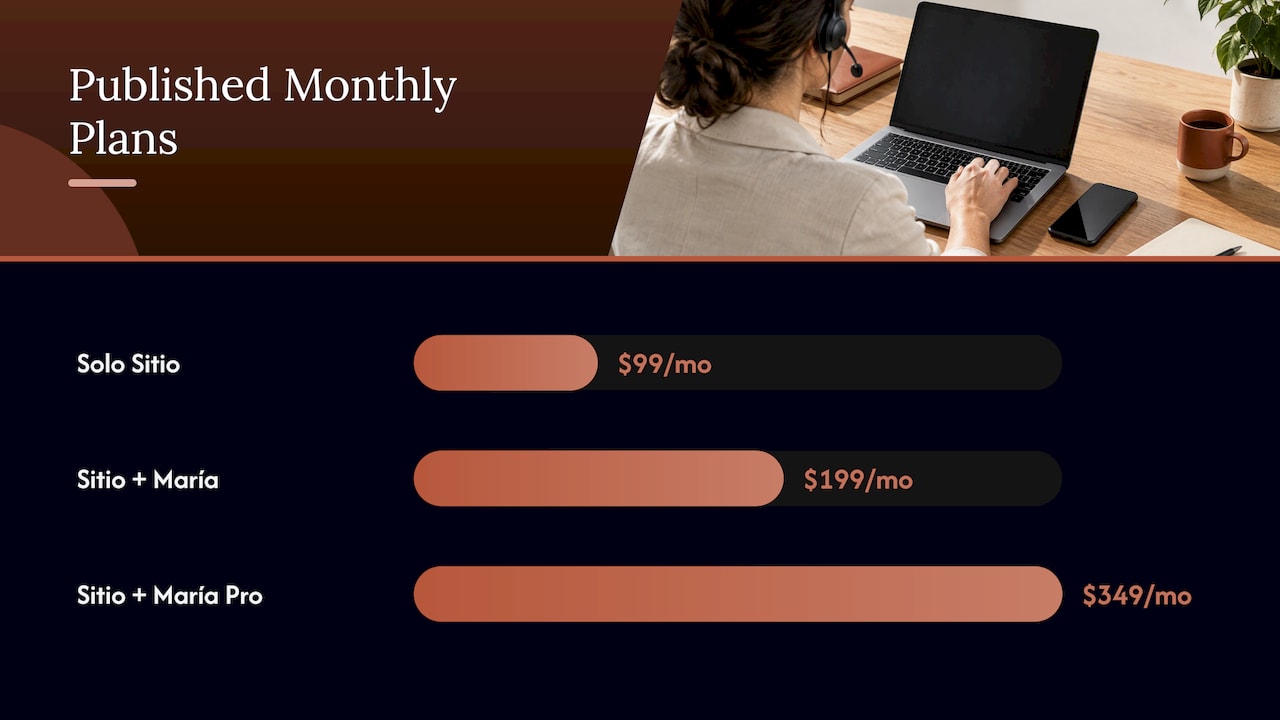
Diazluna publishes its prices:
| Plan | Monthly | Annual |
|---|---|---|
| Solo Sitio (bilingual website) | $99 | $990 |
| Sitio + María (website plus AI receptionist) | $199 | $1,990 |
| Sitio + María Pro (managed package with site updates and expanded call capacity) | $349 | $3,490 |
There is a one-off activation fee of $399. Compared with hiring a bilingual receptionist, buying a separate website and paying for a messaging tool from different vendors, a single subscription for all three keeps the bill predictable and the experience consistent across channels.
How to roll it out in four steps
1. Write the scope
List what the receptionist may do and what it may never do, using the table above. Decide your recording policy and the exact AI disclosure language, in English and Spanish. Have a lawyer at the firm, ideally the one responsible for ethics compliance, approve it.
2. Build the intake script
Use the seven-step sequence, adapted to your practice areas. Define your urgent triggers and who receives transferred calls at each hour. Write the Spanish with a native speaker so the questions sound like something your own staff would say.
3. Test with real scenarios
Before going live, run a set of test calls and messages: a routine consultation request, an angry caller, a caller asking for legal advice, a person in custody, a caller who switches between English and Spanish, a wrong number and a call at 2 a.m. Check that the transfer works, the summary is accurate and the receptionist declines advice politely every time. Repeat after any change to the script.
4. Review and measure
Read summaries daily at first, then weekly. Track a handful of numbers: calls answered, intake forms completed, consultations booked, consultations attended and signed matters, by language. If many Spanish-speaking callers hang up at one question, rewrite it. If urgent calls are being missed, tighten the triggers. The measure that matters is not how many calls the AI answered but how many became consultations.
Our view
We built Diazluna for professionals who are good at their work and are losing people before the first conversation. A Spanish-speaking caller who gets silence, a voicemail in English or a clumsy translation does not think “language barrier”. They think “this office is not for me”.
That is why we put the website, the receptionist and WhatsApp in one place and write the Spanish with human review, not as a translation. The AI takes the first call, collects what your attorney needs and passes urgent matters to a person. It does not practice law, and your team keeps every decision that belongs to a lawyer.
Agencies that sell these pieces separately charge separately and leave you to make them work together. We think a small firm should get one front desk that speaks to clients in their language at any hour.
Francisco
Start with the front desk your Spanish-speaking clients can reach
If your firm serves Spanish-speaking clients, our attorney package puts a bilingual website, a 24/7 AI receptionist and WhatsApp behind one subscription, starting at $99 per month for the website and $199 per month with the receptionist. See how it works for law firms on our bilingual site, phone and WhatsApp page for attorneys, or compare the plans on diazluna.ai.
FAQ
Can an AI receptionist accept a new client for my firm?
No. Accepting a matter is a lawyer’s decision. The receptionist collects the details, notes the conflict-check information and books a consultation, and an attorney decides whether to take the case. ABA Formal Opinion 512 says tasks that require a lawyer’s personal judgment cannot be left to an AI tool alone.
Do I have to tell callers they are talking to an AI?
Disclose it. Pretending to be a human raises misrepresentation concerns under the Rules discussed in Opinion 512, and some states have bot-disclosure laws. Put the disclosure at the start of every call and message, in the caller’s language, and confirm the wording against your state’s rules.
Can the receptionist record calls?
Only with the proper consent. The New York City Bar says an attorney should obtain consent before recording a call with an AI tool, and notes that many states require all parties to agree. Not recording is the safer default, and the NYC Bar suggests avoiding recording non-client conversations. Check your state’s rule first.
Is a bilingual receptionist worth it for a small firm?
If Spanish-speaking prospects call you, yes: every unanswered or misunderstood call is a consultation that goes to another firm. A bilingual setup answers at any hour in the caller’s language and gives your team a written summary. Our guide to the role of an AI receptionist in small bilingual practices explains how it works day to day.
How should I judge whether it is working?
Track consultations booked and signed matters from calls, split by language, and read the summaries for accuracy. The New York City Bar’s guidance is that attorneys should review AI-generated summaries rather than rely on them blindly, so make that a standing weekly task.
Sources
- ABA Formal Opinion 512 (July 29, 2024)
- NYC Bar Formal Opinion 2025-6 (December 2025)
- NYC Bar Formal Opinion 2026-2 (August 2026)
- AI Esquire: Responsible AI for Legal Intake