September 26, 2026
Calculate Up to $114,000 Lost to Missed Calls, Practice

A small to midsize practice missing roughly 1 in 4 incoming calls typically loses tens of thousands to over a hundred thousand dollars a year in direct appointment revenue. That range looks bad enough on its own, but it still understates the real damage, because it ignores lifetime patient value, lost referrals, and staff overhead that keeps burning whether the phone gets answered or not. The section below on measuring your own numbers shows exactly how to size this for your practice.
TL;DR:
- Practices typically lose between $114,000 and over $200,000 annually due to missed new-patient calls, depending on call volume and average visit value.
- The true cost extends beyond missed appointments, affecting referrals, patient relationships, and covering fixed overhead costs, which can significantly amplify losses.
- Implementing call-tracking, staff scheduling, and affordable technologies like auto-attendants and missed-call text-back can recover a substantial portion of lost revenue at a manageable cost.
- Bilingual call handling, through services like AI receptionists and WhatsApp messaging, reduces language barriers that cause silent revenue drops behind missed Hispanic patient opportunities.
- Consistently measuring missed-call rates, answer times, and conversion rates will identify failures and justify investments that can quickly break even through recovered new patient revenue.
Table of Contents
- How to Calculate the Direct Revenue Lost From Missed Calls
- Why the True Cost Runs Higher Than the Missed Appointment Alone
- When and Why Calls Go Unanswered
- How to Measure Your Practice’s Missed-Call Cost
- Practical Fixes and Their Return on Investment
- Clinical Safety and Billing Basics for Phone Handling
- Why Bilingual Access Changes the Whole Equation
- A Bilingual Front Desk That Never Misses a Call
- Sources
- FAQ
How to Calculate the Direct Revenue Lost From Missed Calls
The math behind missed calls cost for a medical practice isn’t complicated, but almost nobody runs it. Most practices know their no-show rate. Almost none track what happens before a patient ever gets scheduled.
You need six numbers:
- Average daily calls — pull this from your phone system or carrier report.
- Percentage of calls from new patients — front-desk staff can usually estimate this within 10%.
- Miss rate — the share of calls that go to voicemail, ring out, or get abandoned in a queue.
- Conversion rate — the percentage of answered new-patient calls that actually book.
- Average revenue per visit — from your billing system, by payer mix if possible.
- Working days per year — typically 250 to 260 for most outpatient practices.
Example A: a small dental or primary care office. Say the practice gets 60 calls a day, 30% from new patients, and misses 1 in 4 of them, which lines up with the industry benchmark, showing that many small practices miss roughly a quarter of incoming calls during peak hours. That’s 18 new-patient calls a day, 4.5 missed. If half of those would have converted at $200 average visit value, the practice is losing about $450 a day, or close to $114,000 a year across 254 working days.
Example B: a five-provider specialty practice. With 200 calls a day and a similar miss rate but a higher average visit value of $400, the same arithmetic produces losses well north of $200,000 annually. Run the numbers with your own conversion rate. Even a conservative 20% conversion assumption on missed calls tends to land in five figures for a single-provider office and six figures once you add providers.
Why the True Cost Runs Higher Than the Missed Appointment Alone
The appointment you lose today is the smallest piece of the problem. A new patient who never gets through the phone isn’t just one missed visit. They’re a missed relationship that could have been worth thousands of dollars over years of recurring care.
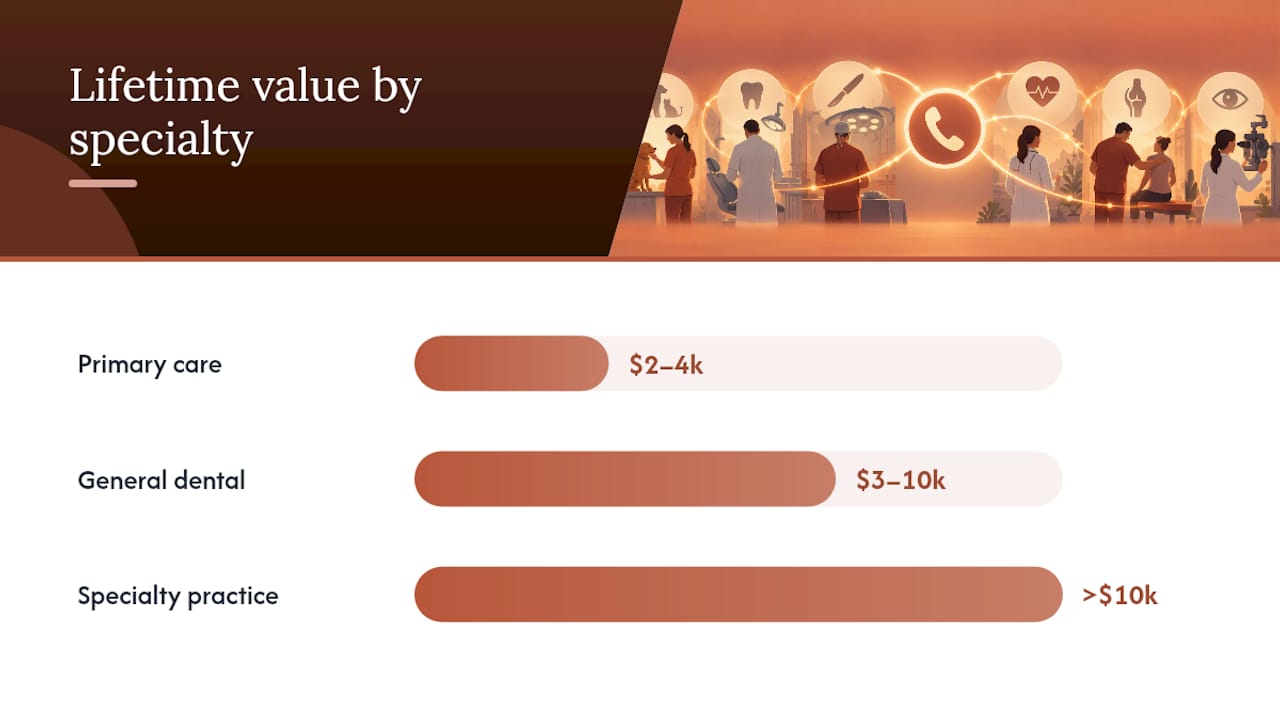
Lifetime patient value varies a lot by specialty:
- A primary care patient can be worth $2,000 to $4,000 over several years of routine visits, labs, and referrals.
- A general dental patient often runs $3,000 to $10,000 across cleanings, restorative work, and family referrals.
- A specialty practice like orthodontics or dermatology can see lifetime value climb past $10,000 once repeat procedures and referred family members are factored in.
The real number: A single missed new-patient call carrying an average value of $125 to $500, as industry benchmarks commonly show, can represent 10 to 20 times that amount once lifetime value is applied instead of a single visit price.
Referral erosion is harder to see but just as costly. A patient who can’t reach your office rarely complains. They just don’t refer their spouse, their coworker, or their parent, and you never know the referral existed. Watch for a falling ratio of new patients citing “referred by a patient” on intake forms. That’s usually the earliest warning sign, well before booked volume itself drops.
Then there’s the fixed-cost leakage nobody puts on a spreadsheet. Rent, staff salaries, and equipment costs accrue whether a 2 p.m. slot is filled or empty. An unfilled slot doesn’t just cost the lost visit revenue. It’s revenue that should have covered a portion of overhead already spent.
When and Why Calls Go Unanswered
Missed calls are rarely random. They cluster around a handful of predictable failure points, and diagnosing which one applies to your practice determines whether the fix is staffing, process, or technology.
- Front-desk multitasking: the person answering phones is also checking in patients, collecting copays, and handling walk-in questions, so calls get triaged behind whoever is standing in front of them.
- Peak-window mismatch: call volume spikes at opening, around lunch, and right after school or work hours end, exactly when staffing is often thinnest.
- After-hours gaps: many practices route evening and weekend calls straight to a generic voicemail with no promise of a callback window.
- No call-back protocol: voicemails pile up without a defined turnaround time, so messages get answered whenever someone finds a spare minute, sometimes a full day later.
- Missing bilingual coverage: a Spanish-speaking caller who reaches an English-only voicemail often just hangs up and calls the next practice on the list.
None of these are exotic problems. They’re staffing math and workflow design, and most practices have never mapped their own call volume against their own staffing schedule to see where the two diverge.
How to Measure Your Practice’s Missed-Call Cost
Guessing at your loss number is a mistake managers make constantly, mostly because the data already exists in three places: your phone system logs, your EHR’s scheduling history, and a quick front-desk time study.
- Pull 30 days of call logs from your phone carrier or VoIP dashboard, showing total calls, answered calls, and average wait time.
- Cross-reference against your EHR to see how many answered calls converted to booked appointments within 48 hours.
- Time-stamp a sample week of front-desk activity to see how often the phone rings while staff are mid-task with a patient at the counter.
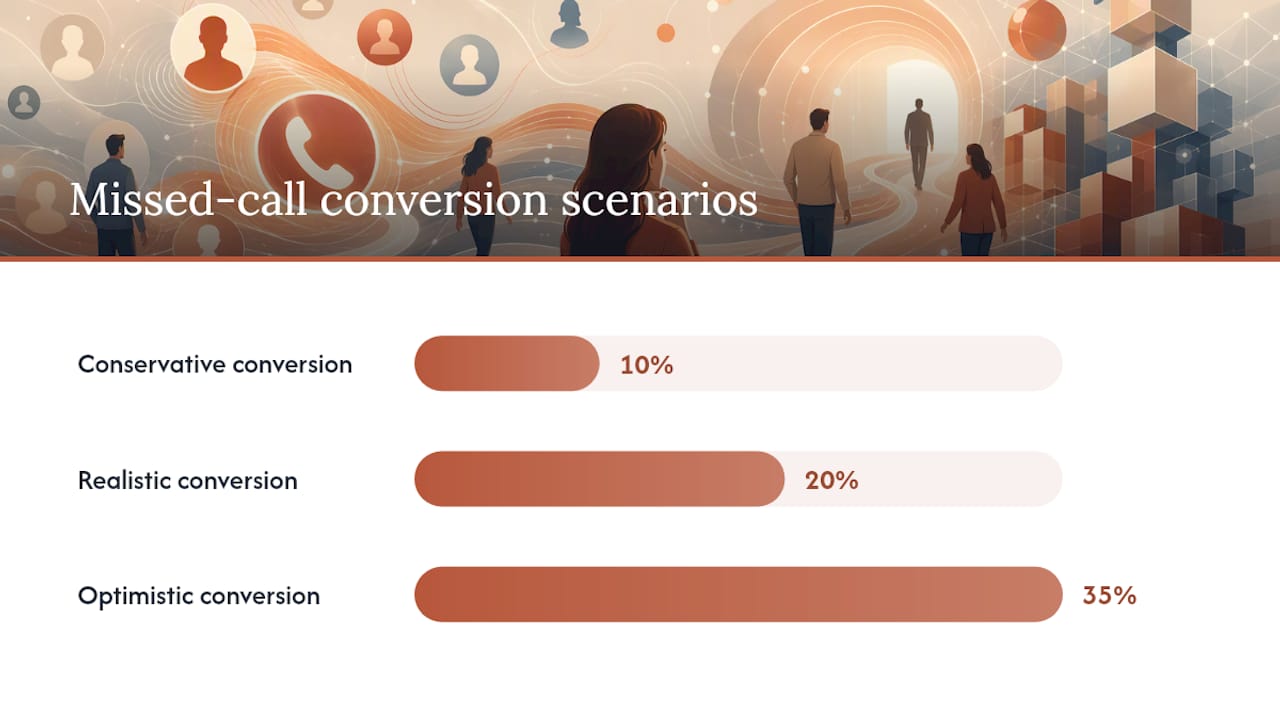
- Run three scenarios: conservative (10% of missed calls would have converted), realistic (20%), and optimistic (35%), multiplied by your average visit revenue.
- Compare the three totals against your current staffing and technology costs to see where the breakeven point sits.
Once you have a baseline, track it weekly with three KPIs: missed-call rate (missed divided by total inbound), average answer speed in seconds, and new-patient conversion rate on answered calls. A dashboard with just those three numbers tells you within a month whether a change is working.
Pro Tip: Run the conservative scenario first and present that number to your team. If a deliberately lowball estimate still shows a five-figure annual loss, nobody in the room will argue about whether the problem is worth fixing.
Practical Fixes and Their Return on Investment
Fixing missed calls doesn’t require ripping out your phone system on day one. Start with the cheapest lever and work up only if the numbers justify it.
Process fixes cost nothing but discipline. A defined callback window, such as returning every voicemail within two business hours, and scheduling buffers that keep one staff member free during known peak call times both recover calls without new spending.
Capacity fixes cost real payroll dollars. Dedicating one staff member to phones during morning and lunch peaks, or cross-training a clinical assistant to answer overflow calls, typically runs a few hundred dollars a week in labor. Administrative staffing data shows front-desk roles are already stretched thin at most practices, which is exactly why overflow coverage tends to fail without a dedicated plan.
Technology fixes scale further per dollar. Options include an auto-attendant that routes calls by urgency, missed-call text-back that automatically texts a caller who couldn’t get through, voicemail-to-text transcription, and full AI or outsourced live-answering services that pick up every call around the clock.
- Missed-call text-back tools often run $50 to $150 a month and typically recover a portion of otherwise-lost callers who reply to the text instead of calling a competitor.
- Outsourced live answering services usually run several hundred dollars a month depending on call volume.
- A 24/7 AI receptionist can cover after-hours and overflow calls at a flat monthly cost, without adding payroll.
Recovering just three to five missed new-patient calls a month at $200 average visit value covers most of these technology costs outright, which is the simplest breakeven math a manager can run before signing a contract.
Bilingual coverage deserves its own line item. A practice serving Hispanic patients that only answers in English isn’t just losing individual callers. It’s cutting off referral chains inside families and communities that often travel together to the same providers, and retention research consistently ties faster, more accessible response to higher patient retention across service industries generally.
Clinical Safety and Billing Basics for Phone Handling
Phone mishandling isn’t only a revenue problem. The AHRQ’s telephone triage guidance warns that poor telephone triage and inaccessible offices contribute directly to misdiagnosis and delayed care, making quick, accurate phone response a patient-safety requirement, not just a convenience.
On the billing side, AMA guidance draws a firm line: basic triage isn’t a billable evaluation and management service. A documented virtual E/M encounter, however, can qualify for reimbursement when it meets specific CPT documentation criteria. Practices should write clear phone protocols, train staff on when a call crosses into clinical assessment, and loop in a coding or compliance specialist before billing any phone-based encounter.
Why Bilingual Access Changes the Whole Equation
Every missed-call calculation in this piece assumes the caller who gets through can actually communicate once someone picks up. That assumption breaks down fast for Hispanic patients routed to English-only voicemail or a receptionist who can’t finish the conversation. Diazluna’s model, pairing a bilingual website with a 24/7 AI receptionist and WhatsApp integration, exists because that access gap is where a lot of quietly lost revenue hides, not just in raw call volume.
— Francisco
A Bilingual Front Desk That Never Misses a Call
Diazluna offers a bilingual front desk platform combining a Spanish and English website, a 24/7 AI receptionist, and WhatsApp messaging to improve client communication efficiently.
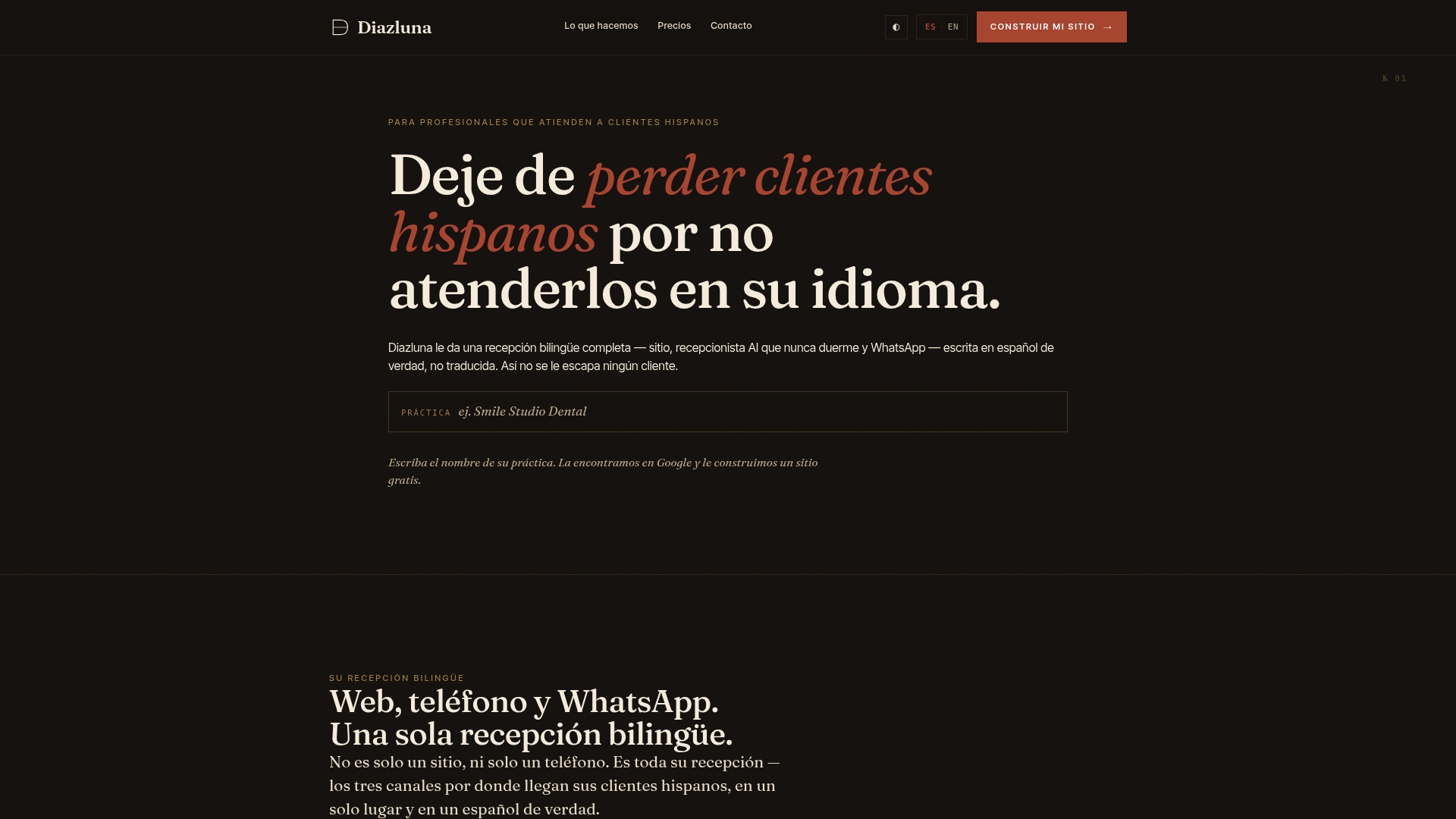
Instead of losing Hispanic callers to a language barrier at 7 p.m. on a Tuesday, every call, message, and WhatsApp inquiry gets answered in the caller’s own language, with urgent cases flagged and transferred in real time. Practices typically see fewer lost patients and get indexed by Google within 24 hours of launch. The Solo Sitio plan starts at $99 a month, with the full Sitio + María package adding the AI receptionist for $199 a month, and a one-time $399 activation fee applies. Run the measurement steps from earlier in this guide, estimate what a 20% recovery rate on missed calls would be worth to your practice, and request a demo to see the numbers against your actual call volume.
Sources
- AHRQ telephone communication / toolkit (telephone triage and patient safety)
- AMA — CPT / evaluation and management guidance
- Prevalence, predictors and economic consequences of no-shows (BMC Health Services Research)
- Solutionreach — Missed calls cost guide (industry benchmarks)
This article is general information, not a substitute for advice from a qualified doctor. Consult a qualified healthcare professional about your own circumstances before acting on anything here.
FAQ
Can Doctors Charge for Telephone Calls?
Generally, brief telephone triage isn’t billable, but a documented virtual evaluation and management encounter can qualify for reimbursement under specific CPT criteria. The call has to meet clinical documentation standards, not just be a quick scheduling or symptom question.
How Much Do Doctors Charge for Missed Appointments?
No-show fees vary widely by practice and state regulation. The deeper cost is the lost visit revenue itself, which peer-reviewed research put at an average of $196 per no-show in one health system analysis.
What Happens if I Miss a Call From My Doctor?
Most practices will leave a voicemail or send a follow-up message, but response protocols vary a lot by office. Practices without a defined callback window sometimes take a full day or more to reconnect, which is exactly the gap that turns a returned call into a lost appointment.
Can You Charge a Patient a No-Show Fee?
Yes, most practices can charge a no-show fee if it’s disclosed in a signed patient policy, though some state Medicaid and Medicare rules restrict or prohibit it for certain patients. Check your state’s specific regulations and payer contracts before applying the fee uniformly.
How Does Diazluna Help Reduce Missed Calls?
Diazluna combines a bilingual website with a 24/7 AI receptionist and WhatsApp integration so calls and messages get answered in Spanish or English around the clock. Plans start at $99 a month for the Solo Sitio website tier, with AI receptionist coverage added in the Sitio + María tier.