November 19, 2026
Spanish Voicemail Scripts for Clinics, Law Firms and Offices
A good Spanish voicemail greeting does four things in under 30 seconds: it says who the caller reached, why nobody picked up, what to leave, and when you will call back. Below you will find ready-to-record scripts in Spanish with English meanings for business hours, after hours, urgent situations and appointment callbacks, plus the wording rules that make them sound like a native office wrote them. If you would rather not have callers reach a voicemail at all, we cover that too: Diazluna’s AI receptionist, María, answers in Spanish and English around the clock.
TL;DR
- Keep the greeting between 6 and 30 seconds: who you are, why you cannot answer, what to do next, when you will call back.
- Use usted, one short instruction at a time, and ask only for name, phone number and reason for calling.
- Record separate versions for office hours, after hours, holidays and urgent situations, and state the emergency instruction in both languages.
- Have a fluent Spanish speaker, ideally from your own community of patients or clients, review every script before you record it.
- A voicemail is a fallback. A 24/7 bilingual receptionist keeps the caller from ever needing one.
Table of Contents
- What a professional Spanish voicemail greeting needs
- Business-hours voicemail script
- After-hours voicemail script
- Urgent and holiday voicemail scripts
- Appointment confirmation and callback scripts
- Bilingual greeting: which language goes first?
- How to make the Spanish sound natural and respectful
- Recording tips that save re-takes
- Why a voicemail is only the fallback
- Replace the voicemail with a bilingual front desk
- A quick checklist before you record
- FAQ
- Sources
What a professional Spanish voicemail greeting needs
Most Hispanic callers who reach an English-only voicemail do not leave a message. They hang up and call the next office. The greeting is your first impression, and for a Spanish-speaking caller it tells them within seconds whether anyone at your practice speaks their language.
A professional greeting has the same skeleton in any language:
- Who you are. The practice or firm name, said clearly.
- Why you cannot answer. Closed, with another patient, in a consultation.
- What to do. Leave a name, phone number and reason for calling.
- What happens next. A promise you can keep, such as a callback the next business day.
Voicemail templates for Spanish commonly run 6 to 30 seconds. Anything longer and callers start talking over the greeting or hang up. If a sentence does not help the caller act, cut it.
Business-hours voicemail script
Use this when the line is busy or the team is away from the desk during the day.
Spanish:
Gracias por llamar a [nombre del consultorio]. En este momento no podemos atender su llamada. Por favor, deje su nombre, su número de teléfono y el motivo de su llamada, y le devolveremos la llamada lo antes posible. Que tenga un buen día.
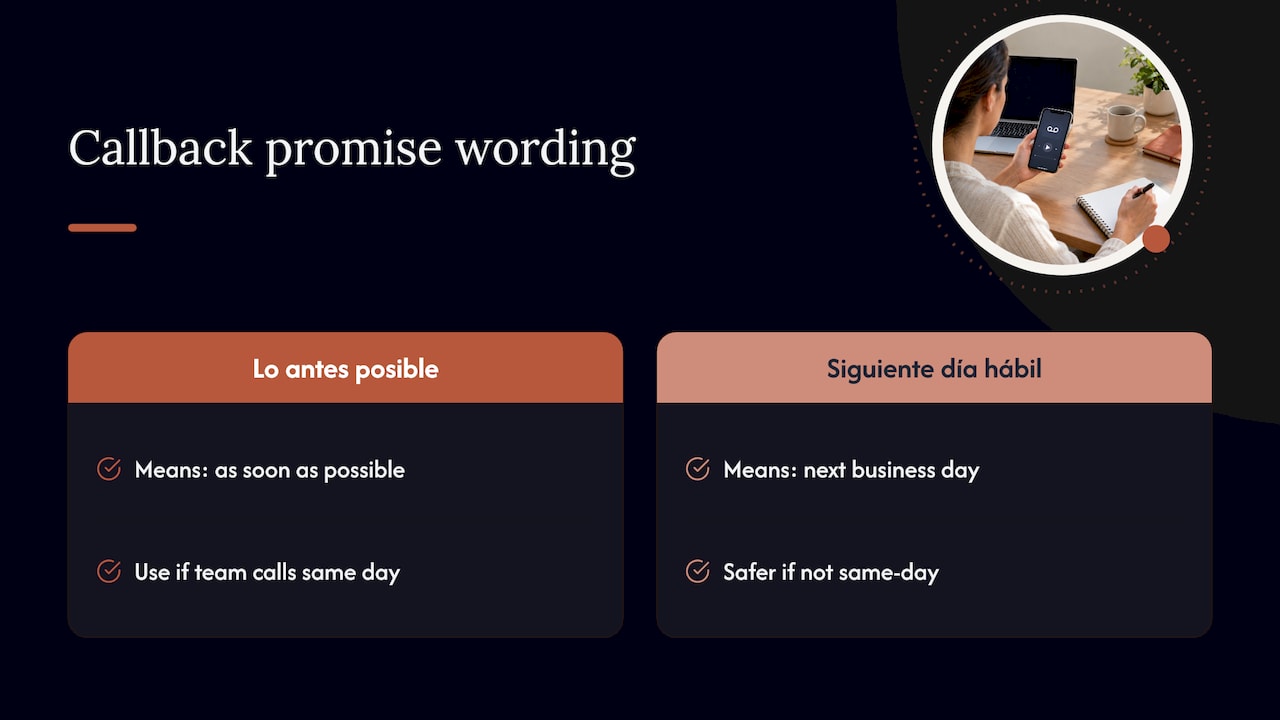
What it says in English: Thank you for calling [practice name]. We cannot take your call right now. Please leave your name, phone number and reason for calling, and we will call you back as soon as possible. Have a good day.
Two details matter here. First, “lo antes posible” (as soon as possible) is only a good promise if your team really calls back the same day. If not, say “el siguiente día hábil” (the next business day), which is the safer commitment. Second, “le devolveremos la llamada” uses the formal le, which sounds respectful to adults you have not met.
After-hours voicemail script
An after-hours message has one extra job: it must give the hours and, for clinics and law firms, say what to do in an emergency.
Spanish:
Gracias por llamar a [nombre]. Nuestro horario de atención es de lunes a viernes, de 9 de la mañana a 5 de la tarde. Si desea dejar un mensaje, diga su nombre, su número de teléfono y el motivo de su llamada después del tono, y nos comunicaremos con usted el siguiente día hábil. Si se trata de una emergencia, cuelgue y marque el 911.
In English: Thank you for calling [name]. Our hours are Monday to Friday, 9 a.m. to 5 p.m. To leave a message, say your name, phone number and reason for calling after the tone, and we will contact you the next business day. If this is an emergency, hang up and dial 911.
A few wording notes for the US market:
- Spell out the time zone if you serve callers across states, for example “hora del Este” for Eastern Time.
- Say “de 9 de la mañana a 5 de la tarde” instead of reading “9 a.m.” literally; it is how people speak.
- For a law firm, replace the emergency line with the instruction that fits your practice, such as the number to call if someone has been detained. Do not invent one: use the number your attorneys actually monitor.
- For a dental office, the emergency line can name the real after-hours number for severe pain or swelling if you have one, and 911 for anything life-threatening.
The recorded after-hours message in both languages should match what is on your website and in your Google listing. A caller who sees one set of hours online and hears another loses trust quickly.
Urgent and holiday voicemail scripts
Urgent situations (clinic):
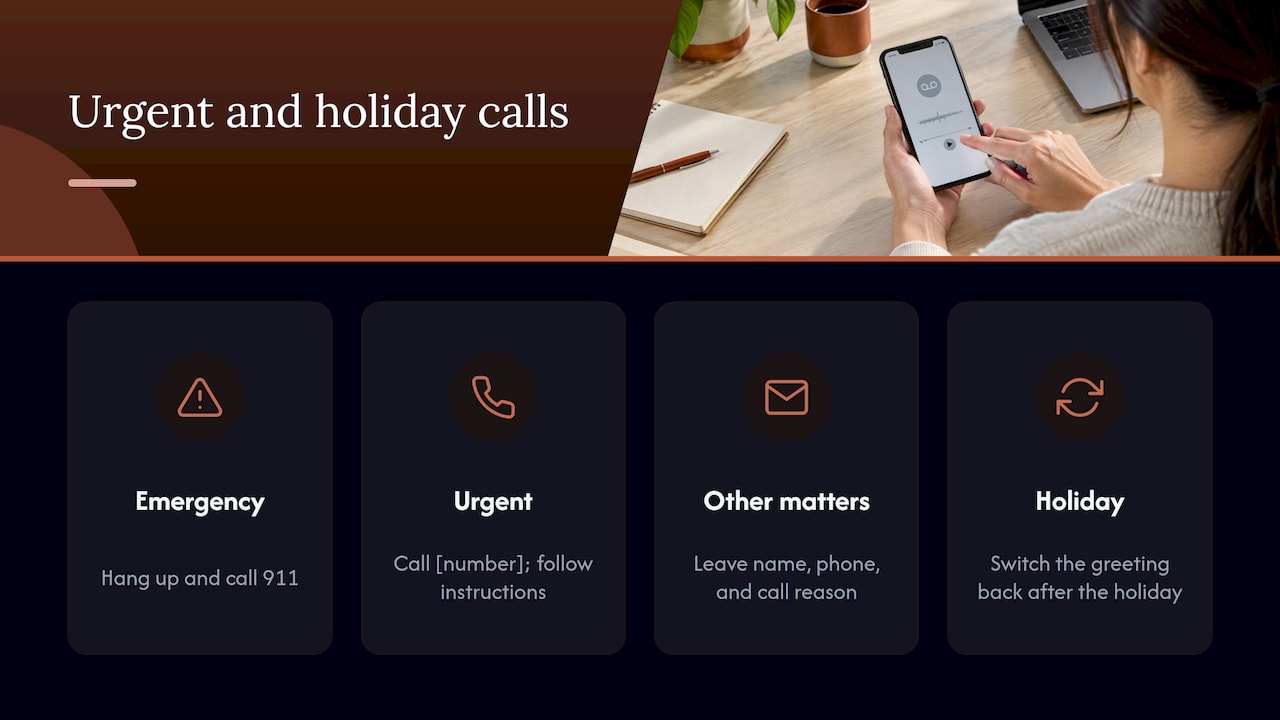
Gracias por llamar a [nombre]. Si tiene una emergencia médica, cuelgue y llame al 911. Si necesita atención urgente y no es una emergencia, llame al [número] y siga las instrucciones. Para otros asuntos, deje su nombre, su número de teléfono y el motivo de su llamada.
In English: Thank you for calling [name]. If you have a medical emergency, hang up and call 911. If you need urgent care that is not an emergency, call [number] and follow the instructions. For anything else, leave your name, phone number and reason for calling.
Holiday closure:
Gracias por llamar a [nombre]. Nuestra oficina está cerrada por el día festivo y regresamos el [día]. Deje su nombre, su número de teléfono y el motivo de su llamada. Si es urgente, escríbanos a [correo electrónico].
In English: Thank you for calling [name]. Our office is closed for the holiday and we return on [day]. Leave your name, phone number and reason for calling. If it is urgent, email us at [email].
Remember to re-record or switch the holiday greeting back. A message promising a return on a date that has passed is worse than none.
Appointment confirmation and callback scripts
When your team calls a patient or client and reaches their voicemail, the message you leave matters as much as the greeting you record.
Confirmation voicemail:
Buenos días, le habla [nombre] del consultorio [nombre]. Le llamo para confirmar su cita del [día] a las [hora]. Si necesita cambiarla, llámenos al [número]. Muchas gracias.
In English: Good morning, this is [name] from [practice]. I am calling to confirm your appointment on [day] at [time]. If you need to change it, call us at [number]. Thank you very much.
Returning a missed call:
Buenas tardes, le habla [nombre] de [oficina]. Recibimos su llamada y con gusto le ayudamos. Puede llamarnos al [número] o responder a nuestro mensaje por WhatsApp.
In English: Good afternoon, this is [name] from [office]. We received your call and are happy to help. You can call us at [number] or reply to our WhatsApp message.
Two cautions for these outbound messages:
- Keep private details out. Say the day and time, not the procedure, diagnosis or case. A voicemail can be heard by family members or coworkers.
- Know the rules on automated messages. If any part of your outreach is prerecorded or delivered automatically, check whether it counts as a call under federal law. Ringless voicemail is treated as a call under the TCPA, so consent matters before you send automated voicemails to patients or clients.
For text reminders that Spanish speakers actually answer, see our Spanish appointment confirmation text templates.
Bilingual greeting: which language goes first?
Many offices record one message in both languages. Two simple rules keep it short enough to work:
- Put the language most of your callers speak first. If you are in a community where most callers are Spanish speakers, lead with Spanish.
- Keep each half to a few sentences and do not translate every word. The point is that the caller hears their language in the first five seconds.
A compact version:
Gracias por llamar a [nombre]. Para español, quédese en la línea. Thank you for calling [name]. If you would like to leave a message in English, please stay on the line.
Then follow with the instructions in each language. If you run a phone menu, offering English or Spanish at the very start is cleaner than a long double message; our guide to a Spanish phone menu walks through how to set that up so callers are not lost.
How to make the Spanish sound natural and respectful
A script can be grammatically correct and still sound like a translation. These habits separate the two.
Use usted with adults
Address adult patients and clients with the formal usted. Dental-office Spanish training stresses using usted, giving one short instruction at a time, and confirming. Formal phone forms such as “¿Podría repetirlo, por favor?” are what the University of Texas at Austin’s Spanish course teaches for phone conversations, and the same register works on a recorded message.
Ask for two last names
Many Hispanic callers have two last names, and shortening or reordering them causes mismatches in your records. Ask callers to spell both without shortening or reordering. In a voicemail you can say: “Diga su nombre y sus dos apellidos, y deletree si es necesario.” For spelling aloud, a phone-practice page shows the style of spelling a name letter by letter, such as erre, u, i, zeta for Ruiz.
Read numbers slowly
For phone numbers, dates of birth and times, say them back in groups. The same dental training advises repeating numbers in groups, and it works in a recording too: “tres, cero, cinco… cinco, cinco, cinco… uno, dos, tres, cuatro.”
Write for the ear, not the page
Everything in a voicemail is heard, never seen. Amazon’s sample healthcare voice-agent instructions note that dates and times must be converted to natural spoken form and that questions should come one at a time. Write “el martes quince, a las diez y media de la mañana”, not “Tue 11/15 10:30”.
Match the callers’ Spanish
US Hispanic callers come from many countries. Avoid slang and regional words in the greeting. Choose neutral vocabulary: cita for appointment, consultorio or clínica for office, mensaje for message. If you want a short set of business Spanish expressions to build confidence, this page lists direct phrases for business Spanish.
Get a fluent reviewer
Translation software and a high-school Spanish class do not guarantee a message that sounds respectful. Have a fluent speaker listen to the recording, not just read the text. Pay attention to tone, to the way numbers are said and to whether anything sounds like a literal English sentence.
Recording tips that save re-takes
- Record in a quiet room with no hum from fans or street noise.
- Smile slightly and speak at a steady pace, a little slower than normal conversation.
- Say the callback number twice if it is not the number they are calling.
- Play the finished greeting from a mobile phone, as callers will hear it on one.
- Put a review date in your calendar so hours, holidays and numbers stay accurate.
Why a voicemail is only the fallback
A greeting, however well recorded, still asks a caller to wait for a callback. For a patient with a toothache or a person who needs a lawyer today, that wait often means calling somewhere else. Messages also pile up overnight and over weekends, and someone has to listen to each one, decipher a name and write down a number.
That is the gap a bilingual front desk closes. If you are keeping the voicemail for after hours, think about what happens to the messages afterward: voicemail transcription for Spanish callers is one way to turn recordings into text your staff can act on fast. For wording beyond voicemail, our Spanish phone scripts for dental offices and copy-ready greetings for medical, dental and legal offices cover live answering. If you want to know how many Spanish-speaking callers you are reaching, see how to track Spanish callers.
Our view
We built Diazluna because we kept seeing the same pattern: a practice invests in a good website, a Spanish speaker calls, and the call ends in an English-only voicemail. The caller does not complain. They just disappear.
A voicemail script is a useful patch, and the scripts above are meant to be used. But we think the better answer is to make sure a Spanish-speaking caller reaches something that talks back. That is why we pair a bilingual website with an AI receptionist that handles calls, messages and appointment scheduling in Spanish and English, 24 hours a day, plus WhatsApp for the many families who prefer to text.
We also care about how the Spanish reads. Our website content is human-reviewed rather than machine-translated, because a respectful tone is the thing people notice first. And when a call is urgent, the system sends a real-time summary and transfers it to your team.
Whatever you decide, record the script, test it, and keep it current. Your callers will notice.
Francisco
Replace the voicemail with a bilingual front desk
Diazluna combines three things in one monthly subscription: a bilingual website in Spanish and English, an AI receptionist that manages calls, messages and appointment scheduling around the clock, and WhatsApp integration. Urgent cases are transferred to your team with a real-time summary.
The plans, as published on our site:
| Plan | Monthly | Yearly |
|---|---|---|
| Solo Sitio (website) | $99 | $990 |
| Sitio + María (website and AI receptionist) | $199 | $1,990 |
| Sitio + María Pro (managed, with site updates and expanded call capacity) | $349 | $3,490 |
There is a one-time activation fee of $399. See the plans and pricing, or look at the pages built for dentists and law firms.
A quick checklist before you record
- The greeting names your practice and is under 30 seconds.
- Hours match your website and Google listing.
- It asks only for name, phone number and reason for calling.
- The emergency instruction is in the message, in both languages.
- A fluent speaker has listened to the recording.
- Callback promises are ones your team can keep.
- Holiday versions have a date to be switched back.
FAQ
How long should a Spanish voicemail greeting be?
Aim for 6 to 30 seconds. Most business greetings fit in 15 to 20: the name of the practice, the reason you cannot answer, what to leave and when you will respond. Templates for Spanish greetings are generally built around that range.
Should the Spanish or the English come first?
Put first the language most of your callers speak, and keep each half short. If you serve many Spanish speakers, leading with Spanish tells them immediately that they are in the right place. A menu that offers both languages up front is cleaner than two long messages.
Is it better to say tú or usted in a voicemail?
Use usted with adults. It is the respectful form for a clinic, law office or any service business, and it is what Spanish training for dental offices recommends for adult patients. Switch to tú only for children or if a caller clearly invites it in a live conversation.
Can I leave appointment details in a voicemail?
Keep them minimal. Give the day, time and a callback number, and leave out the procedure, diagnosis or case details. Anyone nearby may hear the message, and a short, plain message is easier for the caller to act on.
Sources
- Voicemail Spanish greeting scripts and length guidance
- Spanish for the Dental Office: Essential Phrases by Role
- Superior Spanish, Task 09: phone expressions (University of Texas at Austin)
- Spanish Phone Call Dialogue and Practice
- Sample healthcare call center voice-agent prompt (AWS samples)
- Ringless voicemail and the TCPA
- Direct phrases for business Spanish