November 15, 2026
Title VI Language Access: What U.S. Practices Need to Know
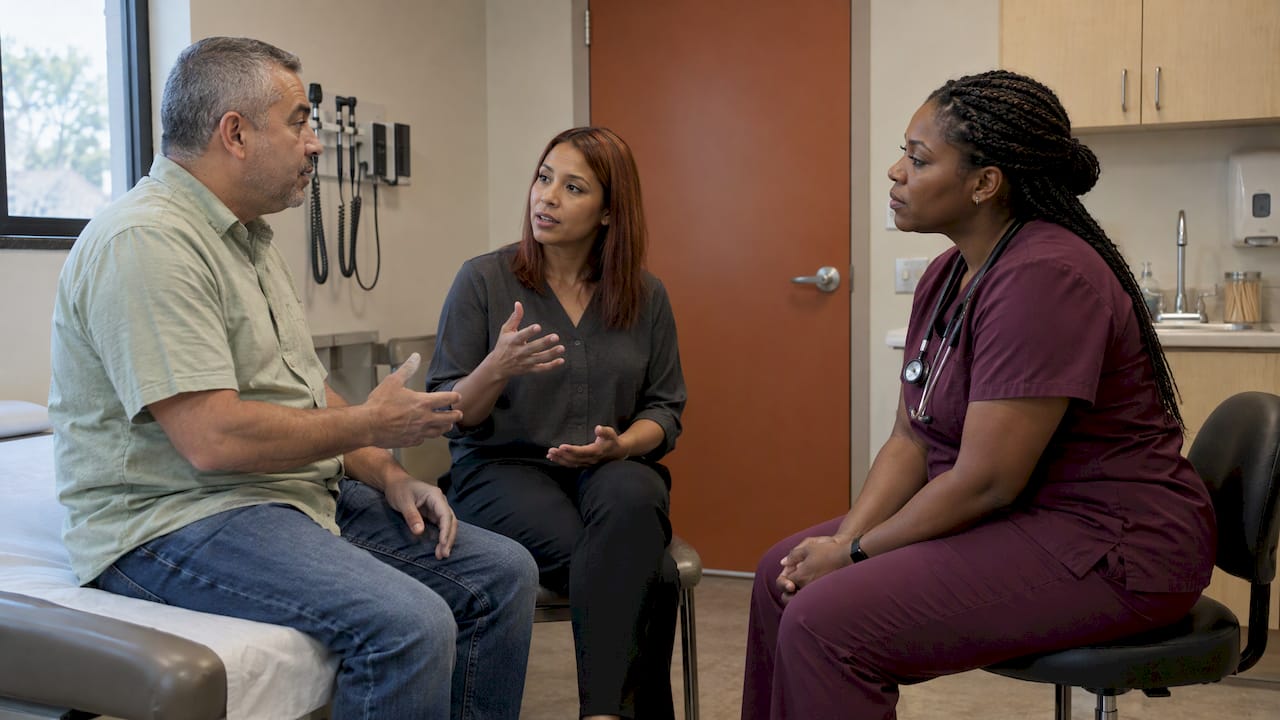
Title VI language access means that if your organization receives federal financial assistance, you must take reasonable steps to give people with limited English proficiency (LEP) meaningful access to your services. For a practice with Spanish-speaking clients, that comes down to three things: answering the phone in their language, translating the documents that matter, and using qualified interpreters instead of family members or free translation apps. Federal guidance has been rescinded in part since 2025, but the underlying law has not changed, and a bilingual front desk is the most visible place where it shows up.
TL;DR
- Title VI of the Civil Rights Act of 1964 covers organizations that receive federal financial assistance, such as Medicaid-funded health care providers. It requires reasonable steps toward meaningful access for LEP people.
- “Reasonable” is judged case by case with four factors: how many LEP people you serve, how often, how important the service is, and what you can afford.
- In 2025 the DOJ rescinded its 2002 LEP guidance, but it stated that recipients must still comply with Title VI and its regulations.
- Health care entities also face Section 1557 rules: free language help, qualified interpreters, and human review of machine translation for critical text.
- A written language access plan, with a bilingual first point of contact, is the practical way to show you took reasonable steps.
Table of Contents
- What Title VI requires, in plain terms
- The four factors that decide what is “reasonable”
- What changed in 2025 and 2026
- Health care: Section 1557 adds specific rules
- What meaningful access looks like day to day
- Build a language access plan in five steps
- Where Diazluna fits
- Our perspective
- FAQ
- Sources
What Title VI requires, in plain terms
Title VI prohibits discrimination based on race, color and national origin in any program or activity that receives federal money. Its regulations require recipients to take reasonable steps so people with limited English proficiency can reach their programs. The DOJ lists recipients as federal, state and local governments, schools, health care, housing and transportation providers, and other recipients of federal financial assistance.
The key phrase is “meaningful access.” It does not mean you must employ an interpreter for every language. It means a Spanish-speaking patient or client should be able to learn about your services, book, understand what they are signing and receive care or advice without a language barrier blocking the way.
Does it apply to your practice?
The trigger is federal financial assistance, not the size of your business or the kind of work you do. HHS says its Title VI duties reach hospitals, nursing homes, home health agencies, managed care organizations, state Medicaid agencies, Head Start programs and physicians who receive HHS assistance. HUD applies the same rule to recipients of its housing funds.
In practice:
- Dentists and medical practices that take Medicaid or CHIP payments, or receive other federal health funding, should assume they need to ask the question.
- Law firms are usually outside Title VI unless they take part in a federally funded program, such as a funded legal aid project.
- Other small businesses are covered only if they receive federal assistance, for example through certain grants.
Whether a specific payment stream counts as federal financial assistance is a legal question. Ask your attorney or compliance adviser before you decide you are in or out. Many practices serve Spanish-speaking clients well regardless, because it keeps clients from walking away.
The four factors that decide what is “reasonable”
HHS explains that the duty starts with an individualized assessment of four factors:
- The number or proportion of LEP people, such as Spanish speakers, who are eligible to be served or likely to be encountered.
- How often LEP individuals come into contact with your program.
- The nature and importance of the service you provide.
- The resources available and the cost of interpretation and translation.
The same guidance adds that there is no one-size-fits-all solution, and what is reasonable for a large provider may not be reasonable for a small one. A three-chair dental office is not held to the standard of a hospital system.
A worked example
Imagine a family dental practice in a neighborhood where many residents speak Spanish at home. Applying the factors:
- Factor 1: Census American Community Survey data shows a large Spanish-speaking share of the neighborhood. SANDAG’s grant guide uses this data as its template for Factor 1.
- Factor 2: Your appointment log shows Spanish-language calls or requests several times a week.
- Factor 3: Dental care, including pain, consent and treatment costs, is important and time-sensitive.
- Factor 4: The cost of bilingual intake and a qualified interpreter line is modest compared with the volume.
All four point the same way: the practice should have a standing, reliable way to serve Spanish speakers. That is the logic you document in a plan.
What changed in 2025 and 2026
If you searched this topic recently, you saw conflicting headlines. Here is the sequence, because it explains what still binds you.
- March 1, 2025: Executive Order 14224 designated English as the official language and revoked EO 13166, the 2000 order that required federal agencies to maintain language access plans. The DOJ then rescinded its 2002 LEP guidance and stated that recipients still have to comply with Title VI and its regulations.
- July 14, 2025: An Attorney General memo said the DOJ would rescind prior Title VI LEP guidance, suspend LEP.gov and issue new guidance on a set timeline. The same memo says agencies are not required to stop producing every multilingual document or service.
- March 4, 2026: Treasury rescinded its own Title VI language access guidance, finalized in 2005.
The lesson is that the guidance documents moved, while the statute and regulations stayed. The law Congress passed in 1964 is not undone by an executive order. A prudent practice keeps its plan, because the enforcement picture can change again and because the Section 1557 rules below apply to health care separately.
A state or local rule may also apply to you. The Congressional Research Service notes that language-access duties for federally funded programs come from Title VI, its regulations and agency guidance, while specialized statutes cover areas like disaster preparedness and voting. Check your state’s requirements as well.
Health care: Section 1557 adds specific rules
For medical and dental practices, Section 1557 of the Affordable Care Act sits on top of Title VI and is more specific. Under the rule at 45 C.F.R. § 92.201, covered health entities must:
- provide language assistance services free of charge, accurately and on time;
- offer qualified interpreters and qualified translators;
- have a qualified human translator review machine translation of text that is critical to rights, benefits or meaningful access.
HHS also states that covered entities must post taglines in the top 15 languages spoken by LEP individuals in each state saying language help is available, and they may not rely on low-quality video interpreting or unqualified staff.
If you run a clinic, our guide on Section 1557 language access policies walks through the policy side in more detail.
Who counts as a qualified interpreter
A qualified interpreter must be proficient in spoken English and at least one other language, interpret accurately and impartially with the specialized vocabulary the setting needs, preserve tone, and follow confidentiality ethics. Only designated bilingual staff with demonstrated proficiency may provide in-language services directly, as the Health Law Institute’s 2024 explainer describes.
This is why the common shortcuts fail. A DOJ Office for Victims of Crime presentation says that family members, friends, uncertified co-workers and Google Translate are not appropriate interpreters. The bilingual cousin who comes with the patient, or the receptionist who took two years of high school Spanish, is not a compliant solution. For the business side of that point, see why translation accuracy matters for professionals.
What meaningful access looks like day to day
Vital documents
The same DOJ presentation says recipients should provide free oral language services and free translations of vital documents: consent and complaint forms, intake and application forms with important consequences, notices of rights, notices of denial or loss of benefits, and notices that language help is free.
The federal safe harbor gives a practical yardstick. A language is a safe harbor language when it is spoken by 5% or 1,000 LEP persons, whichever is less, of the population eligible to be served or likely to be encountered. Providing vital documents in every safe harbor language is considered strong evidence of compliance with written-translation duties. For most U.S. practices, Spanish is the first language to check.
The first point of contact
Most language barriers happen before the visit: the call, the website, the booking form, the text message. The DOJ’s guidance on digital portals recommends language fields near the start of the portal, a drop-down of the roughly 20 languages most often encountered in your area, and questions about interpreter needs. It also suggests alternatives for people without reliable internet access.
For telehealth, HHS says reasonable steps apply to information about availability, scheduling and the appointment itself, and your platform should support a telephone or video interpreter joining the session.
That means a Spanish-speaking person should be able to find your hours, understand how to book and reach someone in Spanish at any hour, not just when a bilingual employee is in the building. Our bilingual appointment policy template shows how to write that down for your team.
Law firms and other professionals
Even when Title VI does not reach you, the competitive logic is the same. A Spanish-speaking prospect who cannot get a call returned in Spanish will call the next firm. Our article on a bilingual law firm website covers how that first impression is built, and the common small business language barrier mistakes show where owners lose clients without noticing. Publishing Spanish pages is only half the work: multilingual SEO content helps those pages get found by the people searching in Spanish.
Build a language access plan in five steps
HHS recommends a plan with five elements. Here is how a small practice can apply each.
- Identify who needs help. Use the four factors. Pull Census data for your area, count Spanish-language contacts in your phone and message logs, and add a language question to intake. The DOJ notes that collecting language data is itself a compliance tool: it shows service gaps and tells you what resources you need.
- Define the language assistance measures. Decide how staff reach a qualified interpreter, how a Spanish-speaking caller is answered, and which documents are translated by a qualified translator.
- Train staff. Everyone who touches the front desk should know the procedure, who the designated bilingual staff are, and that family members are not used as interpreters.
- Give notice. Post signs and web notices saying free language help is available, in Spanish as well as English.
- Monitor and update. Review your logs, complaints and the law at least once a year. The SANDAG guide says a plan should detail how it is monitored, evaluated and updated.
If you are in health care, our language access plan for healthcare walks through the same structure with healthcare examples. For ADA overlap, the multilingual ADA steps for U.S. practices is the companion read.
Where plans usually go wrong
- The plan exists on paper, but no one at the front desk has seen it.
- Spanish is handled by one bilingual employee who is out sick or at lunch.
- The website is a machine translation nobody reviewed.
- After-hours calls go to a voicemail in English only.
Each of these is a gap in step 2, 3 or 4, and each is fixable with a defined procedure and a dependable first point of contact.
Where Diazluna fits
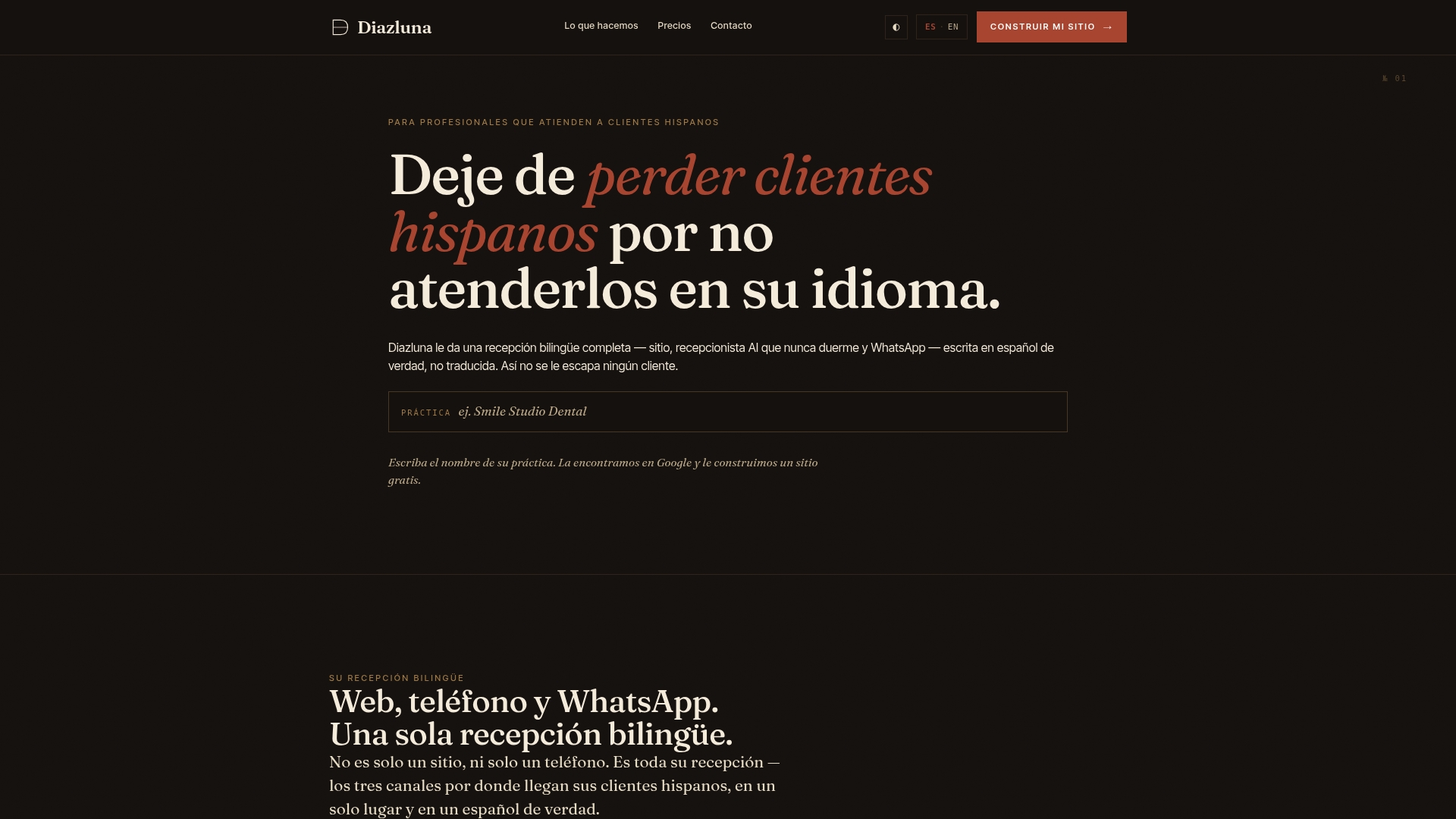
Diazluna is a bilingual digital front desk for dentists, lawyers, health care practices and other professionals who serve Hispanic clients. It combines a fully optimized website in Spanish and English, a 24/7 AI receptionist that handles calls, messages and appointment scheduling in both languages, and WhatsApp integration. Urgent cases are transferred, and you get real-time summaries. The Spanish content is human-reviewed rather than machine-translated, so the first contact reads the way a native speaker would write it.
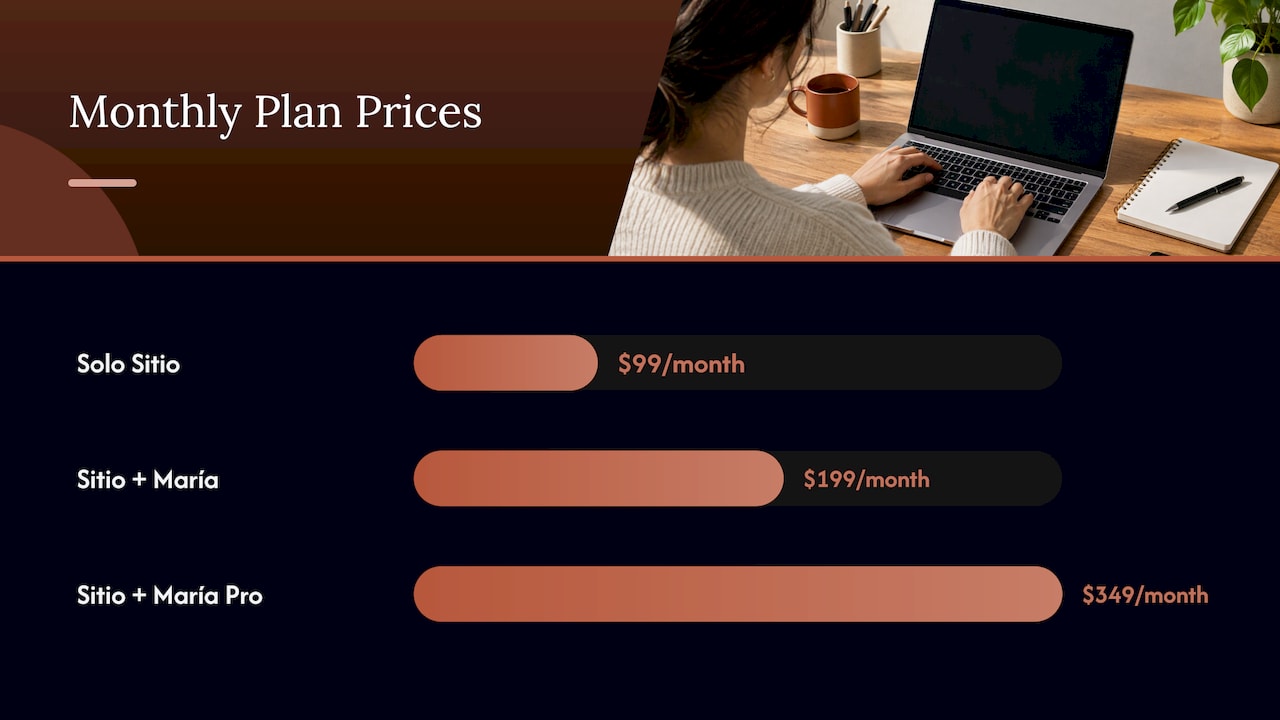
Site setup is free, and plans are published as monthly or annual subscriptions:
| Plan | Monthly | Annual |
|---|---|---|
| Solo Sitio (website) | $99 per month | $990 per year |
| Sitio + María (website and AI receptionist) | $199 per month | $1990 per year |
| Sitio + María Pro (managed, with site updates and expanded call capacity) | $349 per month | $3490 per year |
There is a one-time activation fee of $399. You can see the plans on the Diazluna site and start from the pricing page.
For an overview of how owners compare options by budget, see our guide to affordable bilingual support options.
Our perspective
Most of the practices we talk to are not trying to dodge a rule. They are losing Spanish-speaking clients at the first touch: a call that rings out after 5 p.m., a website that was run through a translation tool, a form that only exists in English.
Compliance documents matter, and you should have a written plan. But a plan is only as good as the first minute of the relationship. If the website speaks natural Spanish, the phone is answered in Spanish at any hour and WhatsApp works the way your clients already communicate, you have solved the largest part of meaningful access before anyone opens a binder.
That is why we built one integrated front desk instead of three separate services. A website, a receptionist and a messaging channel that each speak Spanish authentically, managed in one place, cost less and leave fewer gaps than stitching together separate vendors.
The legal picture will keep moving. The client who needs to understand their appointment, their consent form or their case will not.
Francisco
FAQ
Is Title VI language access still required after the 2025 executive order?
Title VI is a statute and its regulations remain in force. When the DOJ rescinded its 2002 LEP guidance in March 2025, it stated that recipients continue to have an obligation to comply with Title VI and its implementing regulations. Guidance documents have changed, so check current agency materials and your state’s rules.
Does my dental or medical practice have to comply?
The test is whether you receive federal financial assistance. HHS lists physicians who receive HHS assistance, as well as hospitals and managed care organizations, among covered recipients. Ask your attorney or compliance adviser whether your Medicaid, CHIP or other funding makes you a recipient.
Can a bilingual staff member or a patient’s relative interpret?
Only designated bilingual staff with demonstrated proficiency may provide in-language services directly. Family members, friends and uncertified co-workers are not considered appropriate interpreters in the DOJ presentation cited above. Use a qualified interpreter for clinical or legal conversations.
Is machine translation enough for my website?
For health entities covered by Section 1557, machine translation of text critical to rights, benefits or meaningful access must be reviewed by a qualified human translator. Human-reviewed Spanish content is the safer standard for any professional site.
What should a language access plan contain?
At minimum: your four-factor analysis, the languages needing translated vital documents, how assistance is provided in each language, how you notify LEP persons, how you train staff, and how the plan is monitored and updated. A short written plan that your team actually follows beats a long one that sits in a drawer.
Sources
- DOJ: Language Access in Digital Portals and Data Collection (August 2023)
- HHS: Summary of Guidance to Federal Financial Assistance Recipients Regarding Title VI
- HUD: Limited English Proficiency
- SANDAG: ADA and Title VI Guide
- DOJ Civil Rights Division: Rescission notice (March 2025)
- Attorney General memo implementing Executive Order 14224 (July 2025)
- Federal Register: Treasury rescission (March 4, 2026)
- Congressional Research Service: Overview of Language-Access Requirements
- 45 CFR § 92.201, Meaningful access
- HHS: Section 1557 and meaningful access for LEP individuals
- Health Law Institute: Title VI and Section 1557 explainer (2024)
- DOJ OVC: Civil Rights Requirements on Language Access
- HHS: Guidance on Nondiscrimination in Telehealth
- Multilingual SEO content