August 13, 2026
How to Translate Business Documents Professionally for Your

The most effective approach for U.S. practice owners is a bilingual digital front desk: a professionally translated website and intake forms, combined with a 24/7 AI receptionist and WhatsApp communication in Spanish, all reviewed by native-speaker subject-matter experts. That combination covers acquisition, compliance, and retention in one move.
Four elements are non-negotiable:
- Certified-quality translations for intake forms and consent documents, with an audit trail recording which version each patient signed
- Culturally competent Spanish for all patient messaging, appointment reminders, and WhatsApp templates
- Qualified interpretation for clinical consultations, legal advising, and any high-stakes verbal exchange
- 24/7 call capture in Spanish so no Spanish-speaking caller hits a dead end after hours
The business case is concrete. Practices that invest in genuine Spanish-language phone support report new Hispanic patient volume increasing around 30% after implementing dedicated bilingual access. That figure alone reframes translation from a compliance cost to a growth lever.
Key Takeaways
Translating your practice’s client-facing materials professionally requires a bilingual front desk that covers your website, intake forms, phone, and WhatsApp together, with qualified native-speaker review and a documented audit trail.
| Point | Details |
|---|---|
| Start with website and intake | Translate your home page, booking flow, and consent forms first — highest acquisition and compliance impact. |
| Require qualified review | Use certified translators plus native-speaker SME sign-off for consent and clinical language; hybrid AI+human works for reminders and website copy. |
| Meet Section 1557 obligations | Language assistance must be free, accurate, timely, and confidential; never rely on family members or unqualified staff. |
| Track three launch metrics | Monitor Spanish call capture rate, no-show rate, and incoming Spanish-language web leads from day one. |
| Diazluna as turnkey option | Diazluna combines a bilingual website, 24/7 AI receptionist, and WhatsApp integration with native QA in one subscription. |
Table of Contents
- What does “professional translation” mean for a practice owner?
- What U.S. compliance rules apply to your practice?
- Which documents should you translate first?
- Who should translate your materials, and how do you ensure quality?
- What are your implementation options, and what are the trade-offs?
- How do you choose the right provider?
- How do you launch and maintain bilingual materials after go-live?
- Diazluna gives your practice a complete bilingual front desk
- Sources
What does “professional translation” mean for a practice owner?
For a dental office, law firm, or medical clinic, translating client-facing materials professionally means converting every touchpoint a Spanish-speaking patient or client encounters into accurate, culturally adapted Spanish, with a documented review process behind it. That covers your website home and service pages, intake and consent forms, appointment confirmation messages, phone scripts, voicemail greetings, and WhatsApp templates.
What this definition deliberately excludes: certified attestation of legal documents for court filings, immigration paperwork, or notarized translations for government agencies. That is a separate service with a different workflow. This article is about bilingual business communication for your practice’s day-to-day client interactions.
The deliverables that fall under this definition:
- Website pages (home, services, contact, about)
- Intake forms and medical/legal history questionnaires
- Consent and authorization language
- Appointment reminders and follow-up messages
- WhatsApp and SMS templates
- Phone scripts and voicemail greetings
Tone matters as much as accuracy. A consent form that reads like a machine translated it, or uses the wrong regional register, erodes trust before the appointment even starts.
What U.S. compliance rules apply to your practice?
When federal funding is involved, the rules are specific. Under Section 1557 of the Affordable Care Act and Title VI, covered healthcare providers must offer language assistance services that are free of charge, accurate, timely, and protective of patient privacy. That means no charging patients for interpretation, no asking family members to interpret, and no relying on unqualified bilingual staff for clinical or legal content.
Practical compliance steps every practice should take now:
- Capture language preference at intake and store it in the patient record
- Provide translated notices of language rights (required for covered entities)
- Use qualified translators or bilingual subject-matter experts for consent language
- Keep an audit trail: which language version was served, when, and who reviewed it
- Never route a Spanish-speaking patient through a family member for clinical communication
Law firms serving Spanish-speaking clients face parallel obligations. Ethical and practical considerations for attorneys representing Spanish-speaking clients make clear that relying on family interpreters or unqualified staff creates both ethical exposure and real risk of miscommunication in high-stakes moments.
Which documents should you translate first?
Start where the patient journey starts and where compliance risk is highest. Here is the priority order:
- Website home page and contact/booking flow — this is where Spanish-speaking prospects decide whether to call. A Spanish-language site gets indexed and converts; an English-only site loses the lead before any interaction begins.
- Intake forms and consent documents — highest compliance risk. Certified translation followed by bilingual subject-matter review is the recommended pattern, with an audit trail recording which version the patient signed.
- Phone scripts and voicemail greetings — a Spanish caller who hits an English-only voicemail rarely calls back.
- Appointment reminders and follow-up messages — no-show rates drop when patients receive confirmations in their preferred language.
- WhatsApp templates — for practices already using WhatsApp, Spanish templates extend the reach of every automated touchpoint.
Timeline for a small practice: a focused effort covering the website, intake forms, and phone scripts typically takes 2–8 weeks depending on scope and review cycles. Cost shape runs from low (AI-assisted draft plus one human review pass for website copy) to medium-high (certified translator plus bilingual SME review for consent and clinical language). Prioritizing the top three items first lets you go live with the highest-impact materials while the rest are in review.
Who should translate your materials, and how do you ensure quality?
Lead with the right workflow, not just the right translator. For consent forms and clinical or legal language, use a qualified translator plus a native-speaker subject-matter expert who can verify that the phrasing is both accurate and unambiguous in the target dialect.
Pro Tip: A hybrid workflow, machine-generated draft followed by certified human review, cuts cost and turnaround time for website copy and appointment reminders without sacrificing quality. Never apply that shortcut to consent or clinical terms, where a single ambiguous phrase can compromise informed consent.
Translator and reviewer qualifications to require:
- Demonstrated proficiency in both languages (not just conversational fluency)
- Familiarity with medical or legal vocabulary in the relevant domain
- Commitment to confidentiality and HIPAA-aligned data handling
- Native-speaker review of the final output for tone and register
- Version control and an audit trail for every document
Cultural competence goes beyond vocabulary. Spanish is not monolithic: a Mexican-American patient in Los Angeles and a Cuban-American patient in Miami may read the same sentence differently. The choice between usted and tú signals respect or familiarity, and getting it wrong in a clinical context undermines trust. Plain-language readability in Spanish, targeting roughly a sixth-grade reading level for patient-facing materials, is a practical standard worth building into your review checklist. For more on when to use bilingual staff versus certified translators, the distinction matters especially in legal and clinical contexts.
What are your implementation options, and what are the trade-offs?
For most small practices, an integrated bilingual front-desk platform balances cost, coverage, and compliance better than any single-service alternative. Here is how the main options compare:
- In-house bilingual hire: high coverage and cultural continuity, but expensive, limited to business hours, and dependent on one person’s availability and dialect.
- Freelance or certified translators: strong for one-time document projects; not built for ongoing call capture, appointment scheduling, or 24/7 coverage.
- Agency-managed translation: good quality control for documents, but typically slow, expensive for volume work, and disconnected from your phone and messaging channels.
- AI-first with human review: fast and cost-effective for website copy and reminders; requires a human review layer for consent and clinical language, and needs a clear escalation path for live calls.
- Integrated bilingual front-desk platform: combines translated website, 24/7 AI receptionist, and WhatsApp in one system. Vendor-reported data suggests multilingual AI receptionists can reduce missed visits by up to around 30% and lower front-office costs substantially for some practices.
That last capability matters operationally. Auto language detection and mid-call switching mean a monolingual front-desk team can still serve Spanish callers competently, with a full transcript flagged by detected language for downstream staff. For law firms evaluating AI in their workflows, legal AI automation covers how these tools integrate with practice management systems.
When using AI transcription, verify the vendor’s HIPAA posture. On-device versus cloud transcription carries different PHI exposure profiles, and HIPAA-compliant transcription options vary significantly by implementation.
How do you choose the right provider?
Start with proof, not promises. Ask every vendor these ten questions:
- What is your translation workflow from source text to published output?
- What are your translators’ credentials and domain specializations?
- Can you provide a sample audit trail showing language version and reviewer sign-off?
- How do you handle PHI and HIPAA compliance in your platform?
- Does your AI receptionist auto-detect language and switch mid-call?
- How does the system integrate with our phone system and patient management software?
- What is your 24/7 coverage model, and how are urgent calls escalated to a human?
- Can you show references or documented outcomes from similar practices?
- What is your pricing structure, and are there long-term contract requirements?
- How do you handle translation updates when our forms or policies change?
Red flags that should end the conversation: no native-speaker QA step, reliance on family interpreters as a fallback, no auditable version history, inability to produce translator credentials, and vague answers about HIPAA data handling. For a fuller picture of affordable bilingual support options and what different pricing models actually include, compare cost structures before committing.
How do you launch and maintain bilingual materials after go-live?
Before going live, run through this checklist:
- Test the language-selection flow on your website from a mobile device
- Place a live test call in Spanish and confirm the AI receptionist captures details correctly
- Have a native Spanish speaker with domain knowledge review every intake form
- Confirm the audit trail logs which language version was served and signed
- Test all WhatsApp templates for formatting and tone in Spanish
Ongoing quality control:
- Assign one staff member to own the translation change log
- Collect feedback from Spanish-speaking patients or clients after their first visit
- Schedule a quarterly review of all translated materials against any policy or form updates
- Track three metrics from launch: Spanish call capture rate, no-show rate for Spanish-speaking patients, and incoming Spanish-language leads from the website
- Triage translation fixes by risk tier: consent and clinical language first, website copy second, reminder templates third
When a fix is needed, update the source document and the translated version together, log the change with a date and reviewer name, and re-test the affected touchpoint before republishing.
What actually works in small practices
Most practice owners underestimate how much a single missed Spanish call costs them. It is not just that appointment. It is the referral that never happens, the Google review that never gets written, and the family that goes to a competitor who answered in their language. The practices that see the fastest results are not the ones that spend the most on translation. They are the ones that get the phone and the website right first, then build out from there. A turnkey bilingual front desk removes the coordination burden that makes most practices stall: no managing three separate vendors, no gap between the translated site and the phone system that cannot speak Spanish. When the whole front-desk layer speaks Spanish from the first touchpoint to the follow-up message, the acquisition math changes quickly.
Diazluna gives your practice a complete bilingual front desk
Practices that have gone through this process know the hardest part is not the translation itself. It is keeping every channel aligned: the website, the phone, the WhatsApp, and the intake forms all speaking the same Spanish, with the same tone, updated together when anything changes.
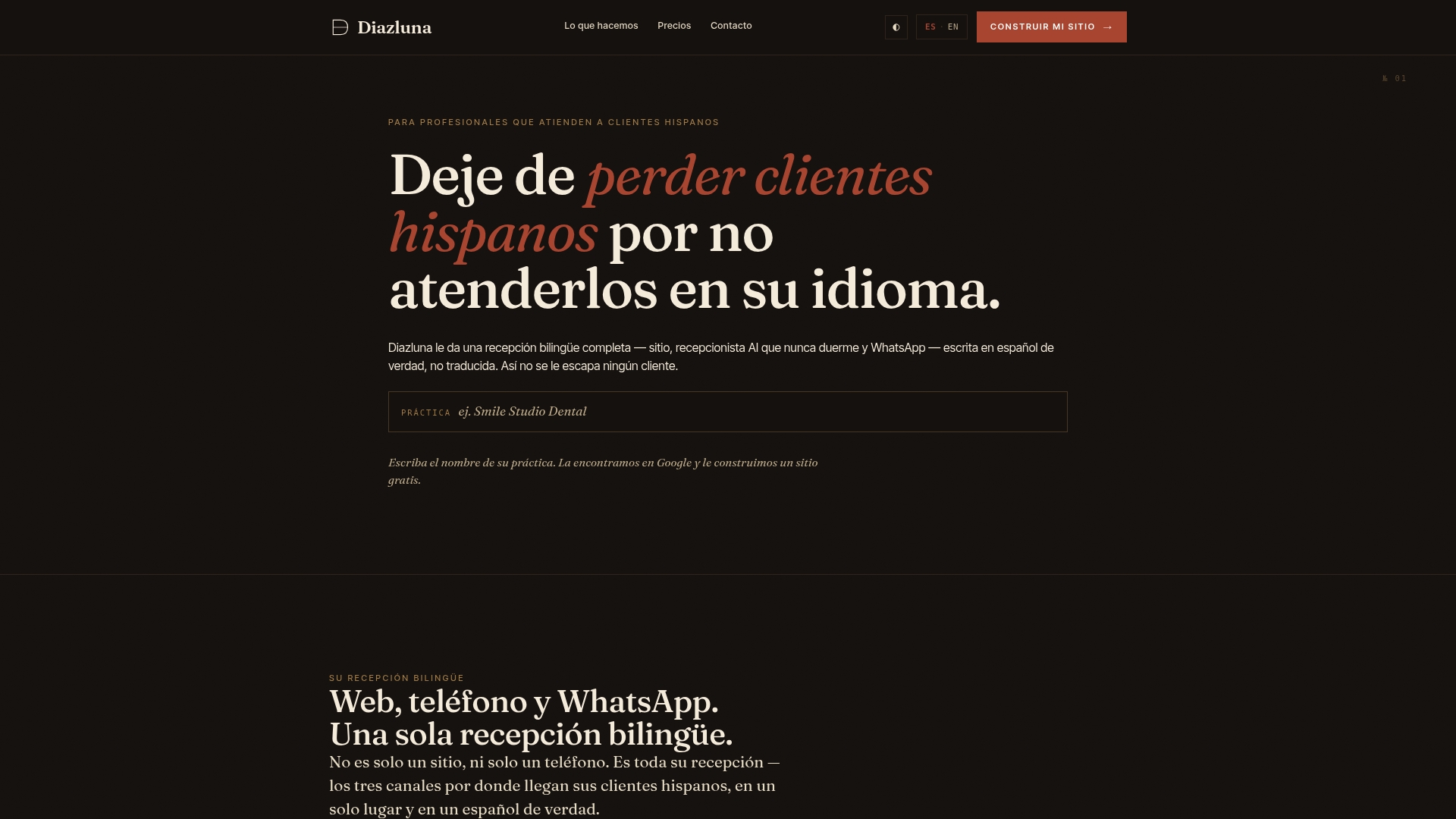
Diazluna delivers all of that as one subscription: a fully translated and Google-indexed bilingual website (indexed within 24 hours of launch), a 24/7 AI receptionist that handles Spanish and English calls, schedules appointments, and routes urgent cases to your team, and WhatsApp integration with native-speaker QA built into the workflow. Practices using Diazluna report a measurable decrease in lost Hispanic leads, without the overhead of managing separate translation, phone, and messaging vendors. See how the bilingual front desk works, or if you run a dental practice, the dentist-specific packages show exactly what is included for your practice type.
Sources
- No Se Habla Espanol: Ethical and Practical Considerations for Non Spanish-Speaking Attorneys Representing Spanish-Speaking Clients
- Bilingual Intake Forms (Spanish/English): Translation, Compliance, and Workflow Guide | Formfy Blog
- 2026 Spanish Bilingual Customer Service Study
- The role of multilingual AI receptionists in breaking communication barriers and expanding healthcare access for diverse patient populations after hours | Simbo AI - Blogs
This article is general information, not a substitute for advice from a qualified lawyer. Consult a qualified legal professional about your own circumstances before acting on anything here.